How much does sign repair cost?
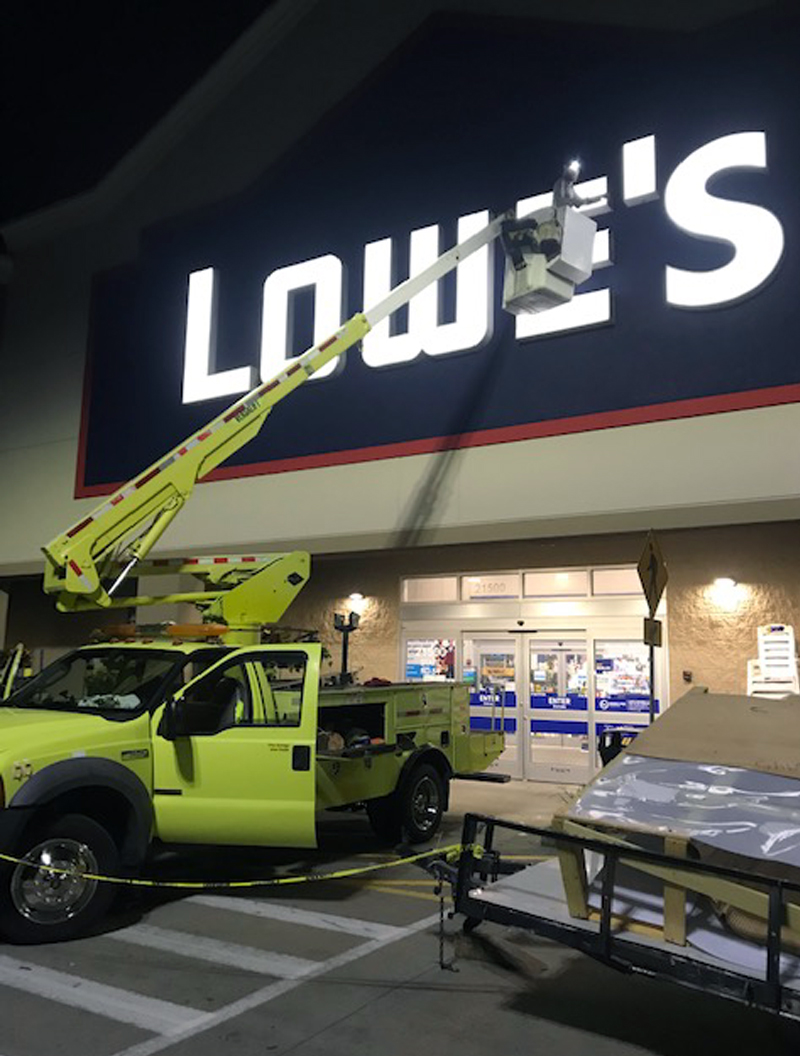
Common neon repairs run about $100 to $500, according to price ranges published by U.S. neon shops in 2026. Prices rise with sign size, height and access — a pylon sign that needs a bucket truck costs more than a window sign carried into the shop.
As published examples, one shop lists $125 for a single transformer replacement and $100 to $200 per new glass tube. LED repairs are usually a power supply or a run of modules. Every job is different, which is why we quote each one after looking at the sign: estimates are free at (727) 420-1858.
Why is my sign flickering or partly dark?
Flickering or dark sections usually come from a failing transformer or LED power supply, a loose or corroded connection, or a cracked neon tube that has lost its gas.
Before calling, check that the breaker and the sign's disconnect switch are on, and check the timer or photocell that turns the sign on at dusk. Do not open the sign. Neon circuits run at thousands of volts, and the National Electrical Code (NFPA 70, Article 600) requires every electric sign to have a disconnect for exactly that reason.
Is LED or neon better for a business sign?
LED is the better choice for most new outdoor signs because it uses less power, runs at low voltage and needs less service. Glass neon is the better choice when the look matters — a vintage sign, a bar or restaurant window, or a historic storefront.
| Glass neon | LED |
|---|
| Light source | Gas-filled glass tube | Solid-state diodes |
| Voltage | High-voltage transformer secondary (thousands of volts) | Usually 12 or 24 V DC |
| Typical life | Tubes 8–15 years or longer; transformers about 5–15 years (published shop figures vary) | Modules commonly rated near 50,000 hours — about 11 years at 12 hours a day |
| Energy use | Higher | Lower; the saving depends on the sign |
| Repairability | High — parts are replaced one at a time | Moderate — failed modules and power supplies are swapped |
| Breakage risk | Glass can crack in storms or on impact | Low |
| Best for | Vintage, artistic and interior signs | Channel letters, cabinets, monuments, pylons |
Repair, restore, convert or replace? Repair when one component has failed. Restore when the sign has character worth keeping but needs paint, new faces and new lighting. Convert to LED when a fluorescent- or neon-lit cabinet is sound but costly to keep running. Replace when the structure is unsafe or the brand has changed. More in our guide to choosing between LED and neon.
How do I maintain an outdoor sign in Florida?
Inspect it once a year and again before hurricane season, which runs June 1 to November 30. Salt air corrodes fasteners and connections along the Pinellas coast, UV fades faces and vinyl, and lightning surges kill transformers and LED power supplies.
A maintenance visit covers cleaning, a connection and seal check, lamp or module replacement, and a look at the mounting hardware. If a storm damages your sign: turn it off at its disconnect or breaker, keep people away from hanging parts or broken glass, photograph the damage for your insurer, and call a licensed sign contractor.
Do I need a permit or a licensed contractor for sign work in Pinellas County?
You need a licensed contractor for any electrical sign work, and a permit for most work beyond a like-for-like repair.
Florida regulates electrical sign contractors under Chapter 489, Part II of the Florida Statutes, through the Department of Business and Professional Regulation. Since HB 1335 took effect on July 1, 2024, section 489.505(19) states that sign specialty electrical contractors may perform both electrical and non-electrical sign work — a fix the International Sign Association and the Southern States Sign Association worked on after some cities had required ES-licensed companies to hire a general contractor for non-electrical jobs. Each city in Pinellas County has its own sign code, so confirm permit rules with the local building department. We handle permitting and engineered drawings.